Aug 15, 2016 Original Short Story, The Daily Post
Song-Bird (A Fragment)
©August 12th, 2016
By Vijaya Sundaram
Every day, Kavita sat at her window, and gazed out, waiting.
What she was waiting for, nobody knew – not her mother, not her father, not her sister, or brother, who were twins, and five years older than she was.
Kavita was five years old, and mute. There was a sweetness to her, an air of abstraction, and her family was protective of her. They had already decided not to send her to school, and since they lived in a part of the country where nobody paid much attention to whether children went to school or not, they were safe from the prying reach of a meddlesome school board.
Kavita would hum tunelessly under her breath, and trace little patterns on the wall with her finger while she waited for her father to come home after work. She would hum tunelessly while watching for her elder brother and sister come home from school.
Kavita watched the animals on the street go about the business. Dogs running, barking and defecating, cats strolling with tails high, leaping onto walls and glaring balefully at everyone, cows strolling about, secure in their holiness, but starved just the same, eating whatever little grass they could scrounge up.
Dabbawallahs would sail by on their bicycles, carrying tiffins to schools and offices. An occasional fight would break out on the streets, and people would intervene in the dusty scuffle and flying of fists.
And Kavita would hum.
Her mother watched over her. The humming did not bother her. It was like the music of her days.
Kavita would turn to her mother after the midday meal, and point to the back door of their one-story house. In the back, outside their high back wall, a gutter flowed, filled with stinking sewage water. A few white hens with red eyes and red crests puck-pucked, rooting about the dusty soil inside the yard, bored, but ever ready to eat bugs. A few, straggly tomato and brinjal plants grew there, and a jasmine bush was heavy with flowers. They had a little patch of spinach growing, too. There were chilies and capsicum, too. Her mother had grown up in a village on a small farm, and knew about growing food. This brought relief to their family, because her father worked as a clerk in an office, and brought in just enough to keep his family housed, fed and clothed. Thank goodness, they owned the house, which had belonged to his father and his father’s father before him.
Kavita, pointing, would ask to go out to the back, and there she’d sit under the shade of a dusty mango tree, and watch the chickens and their three goats. Her mother knew she was safe there, because the wall was high, and there was no gate in the back, so she’d let her sit there, while she went about her chores, washing the clothes, hanging them up to dry, sweeping out the house, watering the plants.
No one knew quite what Kavita was thinking. She hummed and hummed, and did not say a word.
Her mother would listen to All-India Radio while she did her chores, and the sound of it soothed her tired spirit, for she was always tired. The constant worry about her youngest child, a worry which she hid from Kavita made her bones che. She’d sing along.
And Kavita hummed along.
Music flowed in her body like a river. She was surrounded by it, she thought in music, she dreamed in music, and loved in music. And she loved her mother for giving her this music that poured out from the magic box, and made her happy.
And unhappy.
For she wanted, more than anything, to sing.
(Perhaps, to be continued)
___________________________________________________________________
Tags: #DailyPrompt, #Obsessed, #OriginalShortStory, #Postaday, #TheDailyPost
Aug 9, 2016 Original Flash Fiction, Original Short Story, The Daily Post
The Merchant and the Mendicant
©August 9th, 2016
By Vijaya Sundaram
A merchant clad in fine silk came stumbling along the mountain path. Dust covered his clothing, and so were his feet, though he was shod in good sandals. His brown eyes were stark and staring, his neatly trimmed hair and beard were dusty, and his breathing labored.
“I cannot walk any more,” Rajat thought. “This heat is killing me.”
He reached into his cloth bag, and took out a container of nuts and dried fruit and a stoppered metal container filled with water.
“At least, I have food,” he said aloud, to no one.
Someone answered from behind a tree. “Yes, you are fortunate. Could you share some with me? I have eaten only bugs and jamun for two weeks, and I would be grateful for some food.”
Rajat started visibly, but contained himself. His instinct was to cling to his food, but looking at the emaciated man who emerged from behind the tree and stood before him, dressed in dusty orange rags, with a rough growth of beard and matted locks, his selfishness wavered. He noticed that the man held a begging bowl in one hand, and a gnarled walking stick in the other.
“Yes, come join me,” said Rajat, and tipped a handful of nuts and dried fruit into a cloth handkerchief that he pulled out from his bag. He also took out two chappatis and two oranges, and offered one of each to the emaciated man, who refused the bread, but took the orange.
As the mendicant came forward and squatted beside Rajat, he could not help but notice the man’s radiant calmness. There was a stillness in his golden eyes. It perturbed Rajat. Watching the poor man eat slowly, Rajat was unaccountably touched by the trembling slowness of his movements. Rajat had never before paid any attention to the poor. He had spent his life making money, and tending to his family’s needs. When he’d passed the poor, he’d tossed a coin or two into their tin cups, but had never thought of them as people. Now, seeing this starved man, he was struck with a strange wonder, and a rising curiosity.
They did not converse while they ate. After eating, they took turns drinking from the stoppered tin bottle of water he carried. Rajat drank, passed the other his bottle, and was glad to see the mendicant holding the bottle away from his lips. Quietly, they passed the bottle to each other. A few drops fell to the ground when the mendicant drank with slightly shaky hands. The thirsty earth swallowed it up and left no trace.
And still, they said nothing.
Silence prevailed. Little lizards crept out from under the shade of boulders, and scampered across, making little puffs of dust. A staccato sound of a woodpecker broke the silence. Somewhere, they heard the almost-sweet call of an osprey. The earth panted in the heat, and the only cloud in the sky was loose and fluffy, like poorly carded white wool.
“Where are you going?” asked the mendicant.
“I don’t know,” said Rajat, staring into the distance. “I left my home, my wife, my brother, my son, my aging mother, my business. I’m just going, but not sure where.”
He sighed, and felt a stab of pain somewhere in his stomach. Perhaps, it was the food.
He realized that the mendicant was looking at him, waiting. There was a question in his eyes.
“‘Why did I leave,’ you want to ask? Because I’m sure my younger brother slept with my wife. I’ve seen how familiar he is with her, and I see how easy she is with him. Now, I’m not even sure that my son is my own. I couldn’t bear to be around them. I was afraid I’d kill him – or her. So, I said some harsh things, but controlled myself after that. My wife wept and denied it. My brother cursed me for being a suspicious and heartless beast. I didn’t believe either of them. I took my horse, my share of whatever money we had, bid my mother goodbye, and left. I grateful that my mother cannot see or hear very well, and that she doesn’t know what happened.”
The mendicant glanced at him, and was quiet for a time. Then, he spoke. “What about your son?” he asked.
“My son cried, and begged me to take him with me, so how could I not? But then, after the sun beat down on us, he cried again, and said he wanted to go home. What could I do? I set him on the horse, and told my horse to take him home. He knows the way. He’ll be all right.” Rajat tried to summon up indifference, but his voice shook a little.
To make up for this lapse, he reached in again into his bag, and offered him some flat bread again. “Want some?”
“No, thank you. I am content. This food was a luxury. I thank you for your kindness and your company,” replied the mendicant. His formality seemed incongruous, and didn’t suit his attire. His ribs moved as he spoke, and his eyes were hollows. Still, his words of contentment rang like a bell in the silence.
Silence fell again. The merchant laid a cloth on the ground under a tree, and lay down. The mendicant still squatted in the dust, now tracing patterns on the ground with a stick. Raj opened an eye, and said to the mendicant, “You can lie down, too. I don’t mind. What have I to lose? I have already lost everything of value. I am truly poor now. There is nothing left to live for. Perhaps, I should become a mendicant, like you.”
“Are you poor? And is this what you want? What you really want? Sometimes, I think men are fools, fools!” said the mendicant sharply. His eyes were bright in the sun, and his look stopped the merchant’s flood of self-pity.
Rajat was taken aback by this outburst. “What about you? he asked the mendicant. “What are you running from?
“The question is: What am I walking towards? I have given up this world, but I do not despair, like you do. I have no one and nothing to hold me back. I seek contentment. Rage does not fuel me,” replied the mendicant. “I was once a man of means. Then, I was ruined. I didn’t mind. It helped me see clearly for the first time. Still, I wish I had a family or children. I’d have liked that.” His tone was wistful.
“Well, you can have mine!” quipped Rajat bitterly, but stopped laughing when he saw the mendicant’s calm look. “Well, I’m going to sleep You may lie down on this mat with me, if you wish. You’re a strange one, but I like you.” He closed his eyes.
The mendicant said nothing, but quietly laid himself down at the far end of the cloth. The sun beat down less fiercely as a few hours passed. The hot, sticky afternoon wrung itself dry into evening. Purple patches appeared before Rajat’s closed eyes. Green ones followed. He couldn’t sleep, but lay still, hardly moving a muscle. He was sore all the way down to his soul.
Little scampering noises added to the oppressive stillness. A squirrel sat on its haunches, and nibbled a groundnut they had dropped. Its tail flashed in the sun, like a semaphore. Rajat didn’t see it. He had fallen into a swound.
The stars were bright in the sky when Rajat came to with a start. The night air was cool. It came to him in a flash that he had met a mendicant, and spoken with him. He turned to his side to see if the fellow was asleep.
There was no one there. A smell of sandalwood hovered about the place.
Where the mendicant had lain was a pattern of shaved sticks of wood. The sticks pointed to the direction from which Rajat had come. Near it, in the dust was a picture of a house. A little boy and a woman stood beside the house, waving. Beside them stood an old woman. She seemed to be crying. On her other side was a distraught young man. He seemed to be calling out to Rajat.
Rajat stood up, shocked, staring at the pictures on the ground. He looked around, and began to call out for the mendicant, but stopped. He hadn’t even asked him his name.
Heart beating faster, he packed his ground-cloth, and his food and water in his cloth bag. He knew he was wanted at home. He reached down, and looked again at the picture. Underneath it, was a single printed word. It read: Luxury.
And Rajat started back down the path that would lead to homewards.
As he receded from view, a new picture seemed to emerge from the dust. It showed a man walking homewards, towards love.
Just then, a sudden gust of wind rose up out of nowhere. It blew away the sticks, and the pictures in the dust. Nothing remained, not even a footprint. A patter of raindrops fell.
In the distance, an emaciated mendicant walked away, his begging bowl in his hand. No one saw him walk into the gathering clouds. In moments,the horizon swallowed him up.
_____________________________________________________________________
Tags: #DailyPrompt, #Luxury, #Original Short Story by Vijaya Sundaram, #Postaday, #TheDailyPost
Aug 7, 2016 Original Flash Fiction, Original Short Story, The Daily Post
Stubborn
©August 7th, 2016
By Vijaya Sundaram
The five-year old child stomped his feet, and cried. He didn’t want to take his bath. His mother, Rachael, a harassed, overworked nurse, who’d come home from her evening shift just in time for the babysitter to rush out, wanted to get him into his pajamas, and tuck him in bed. She tried to sing to him, reason with him, cajole and coax him. Nothing worked.
Finally, she gave up in exasperation. “Fine, then, let’s just comb your hair, like this. Now, let’s wash your face and ears with a wash cloth like this, scrub your hands, like this, and rinse your feet in the tub. I’ll pour water from this watering can. You can pretend to be a tree. Come on now, Russ, you can do it!”
“I won’t get in,” yelled Russ. Sighing, his mother perched him on the edge of the tub, and rinsed his feet with a jug of water.
While she was helping him into his pajamas in his bedroom, she said, “Why didn’t you want to get in the tub?”
“Because of the monster,” whispered Russ, with his fingers on his lips. The monster doesn’t like me washing in there. The monster gave me a warning twice already. That’s why I wash in the sink. I don’t want my feet inside that tub.”
“What monster, sweetie? There aren’t any monsters here. And besides, you didn’t put your feet in the tub,” said his mother.
Just then, she heard sloshing and stomping sounds coming from the bathroom. For a mad moment, she thought … then, she looked at her son.
His eyes were wide, as he looked at something behind her.
Rachael froze, and something prevented her from looking around.
“I’m sorry I washed in that tub, even if it was only my feet. I promise I won’t do that again,” squeaked Russ to the thing behind her.
“This is your final warning,” bellowed a terrifying voice.
Rachael fainted. When she came to, Russ was asleep in bed, and she was lying in a chair. It was just a horrible nightmare, that’s all, she thought. And Russ is too stubborn for his own good.
She got up to go out of the room, and get to sleep. She was exhausted from a long day at the hospital.
As she went out the door, she thought she heard a sloshing in the vicinity of the bathroom. Her heart thudded.
I will NOT go and investigate, she thought. She turned right around, walked into Russ’s room, locked the door, pushed the dresser against it, and fell back into the rocking chair near his bed.
She lay awake for an hour, and her last thought before she drifted back into an uneasy sleep was, Thank goodness my son’s a stubborn little guy! First thing tomorrow, we’ll leave this god-forsaken place!”
She thought she heard the drain gurgle in the bathroom, and it was music to her ears. Then, she fell asleep, and knew no more.
____________________________________________________________________
Tags: #FlashFiction, #OriginalShortStory, #Stubborn, #TheDailyPost
Jul 27, 2016 Friday Fictioneers, Original Flash Fiction, Original Short Story

PHOTO PROMPT © Janet Webb
Word Count: 100 words of text, exactly
Genre: Realistic Fiction
Drowning
©July 27th, 2016
By Vijaya Sundaram
Leila stood in a corner, sipping water, wondering why she’d attended the party.
It’s not that I’m ugly, she thought. I’m … boring. And I hate small talk.
Well, I won’t stick around, she decided, setting the glass down. She moved towards the door, waving a vague goodbye.
A beautiful woman who had glanced over a few times, detached herself from a group of attractive hipsters and came over.
“Hi, I’m Rona. Want to join us?”
“I’ve got to catch a taxi home.”
“I’ll drive you home. What’s your name?”
“Leila,” she answered. She locked eyes with Rona. Her heart lurched.
_________________________________________________________________
Thanks to Rochelle Wisoff-Fields, our much-admired Fairy Blog-Mother, for hosting us tirelessly at her Friday Fictioneers Salon, and to Janet Webb, for the evocative photograph.
Tags: #FridayFictioneers, #Loneliness, #Love, #Original 100-word Flash Fiction based on a photo-prompt
Jun 23, 2016 Friday Fictioneers, Original Flash Fiction, Original Short Story

Word Count: 100 words of text, exactly
Genre: Realistic fiction
Airborne
©June 23rd, 2016
By Vijaya Sundaram
Settling comfortably in her seat, she looked at her neighbor. His aquiline nose caught the light as he turned and intercepted her frank gaze, his brown eyes bright, expression blank. He looked away.
What if he’s a terrorist? she asked herself with a tremor. Should I tell the steward?
She scolded herself for being paranoid, she, who prided herself for not judging someone by appearances.
Still.
What should I do?
Making up her mind, she said, “I’m Anu. I’m a science teacher.”
He shook her proffered hand. “Firdoos Hassan. Morocco. Physics professor.”
It was the beginning of a beautiful friendship.
_________________________________________________________________
With thanks to Rochelle Wisoff-Fields, Fairy Blog-Mother and friend to all at Friday Fictioneers. Thanks to Rich Voza for his photograph, which has made me spawn three stories.
Tags: #FridayFictioneers, #Original 100-word Flash Fiction based on a photo-prompt, #Passing Casablanca reference
Jun 18, 2016 Friday Fictioneers, Original Short Story, Uncategorized
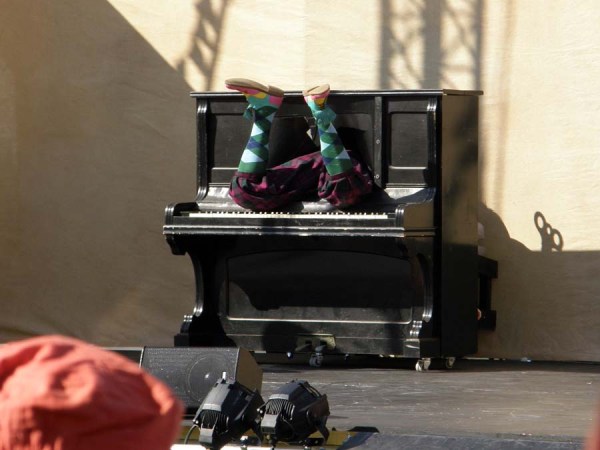
Word Count: 100 words of text, exactly
Genre: Fantasy-Reality Fiction
Pianissimo, Pianissimo!
©June 18th, 2016
By Vijaya Sundaram
After Freddy Zhang came home from his after-school tutoring class, track team, or Robotics Club (he was forced to attend these), his mother made him practise piano first – no snacks until he was done.
Today, Freddy played scales, then stopped abruptly. He hated the piano, viscerally.
“What’s going on?” his mother shouted out.
Silently, he pressed the panels in front of him. They gave way.
“Freddy?” she called out again.
A clockwork key turned on his back. The piano keys moved silently.
Two hands reached out inside from the panels, and grabbed his.
Unresisting, he let himself be pulled in.
_____________________________________________________________
Tags: #FridayFictioneers, #Original 100-word Flash Fiction based on a photo-prompt

Word Count: 100 words of text, exactly
Genre: Realistic, fantastical fiction
Wheel of Fortune
©June 1st, 2016
By Vijaya Sundaram
Jayesh said they would elope that night. He’d told her to wait by the stone hut in the woods. A wheel stood near a boulder there.
Aruna arrived at twilight, as the sun sloped westward in the wheeling skies.
Where was he?
The wheel began spinning. Faster and faster, it went. Images flickered before her.
She saw misery and wretchedness, and violence and death. Her life flashed by. Jayesh’s face was at the center of it all.
Chill struck her heart. Should she leave, or stay? Was this real?
When he arrived, the moon was rising, and she was gone.
___________________________________________________________________
Thanks, again, to Rochelle Wisoff-Fields, Fairy Blog-Mother and friend to storytellers who gather here every week, for hosting Friday Fictioneers, and to Piya Singh, for the photo-prompt.
Tags: #FridayFictioneers, #Non-Elopement, #Original 100-word Flash Fiction based on a photo-prompt

