Vijaya Sundaram

Poet, Musician, Teacher, and Amateur Visual Artist

Perfugium – A 100-word micro-fictional short story

Perfugium
©July 21st, 2016
By Vijaya Sundaram

“What is that, Sire?” clicked Secondus.

Primus, squinting through the periscope at the watery world around them, clicked out a reply.

They’d been stranded in the trenches of the ocean world. Air supplies had diminished, as the plants in their craft died.  They’d risen to the surface just in time.

Their craft bobbed shoreward.  The water fell away; the drowned land rose into view with no sign of life.

A colossal figure holding its torch loomed.

Primus quailed within.  “They must have been giants!” he clicked.

They discerned some writing below – an alien script. 

No matter; they’d finally found refuge.

________________________________________________________________

Titanic Emergence – A 100-word micro-fictional story
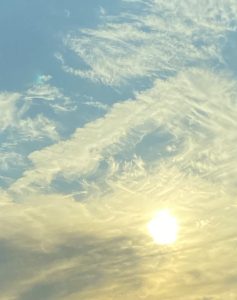
Sky, evening sun, just before sunset, clouds

Photograph by Vijaya Sundaram, Fall 2025

Titanic Emergence
©July 9th, 2014
By Vijaya Sundaram

No one noticed the clouds that day, because people had been forewarned.

The alarm had sounded all over the globe — even the indigenous peoples in forests and hills and distant islands had been informed.  Nobody ventured out.

When the clouds parted, a beam of light shot through and sucked up the entire planet.

Where the Earth was taken, no one knew.  People’s eyes were shut tight, and they felt … translated.

Later, in a newly formed Universe, a new race emerged.  Twelve people straightened up.  Their heads brushed the edges of space.

“Let it begin again,” said Time.

And it did.

_______________________________________________________________________________________________

Every Night – Micro-fiction, maybe?

Every Night
©Vijaya Sundaram

Every night, it’s the same.  You stay, frozen at your computer, looking at your half-written novel, your fingers poised pertly on the keys, your formerly strained back feeling nothing, your mind blank.  Something prompts you, and you get up, and go downstairs.  Always, always, you want to go downstairs, and then come back up.  It’s the thing you do.  Your restlessness vies with your stillness – you, the wormhole with calm and storm on either side, form the passageway.

Now, you’re on your way back up.

It’s strange to go up the stairs every time.  You walk, your feet making no sound, your eyes seeing no light, your hand barely touching the banister. It is past three a.m.  You know that you’d just been down, as was your wont, to get your water, and look at the blue pinpoint lights of the oven, the microwave, the on-demand water heater on the far wall, the blue light spilling on snow-muffled trees, the pre-dawn violet of the sky.  You feel the air moving past your limbs, but it’s strange how stunned your eyes are by the dark, and how you see nothing but faint outlines of light-catching things, so many all around, moving, shifting, blooming into light then dark, all else shrouded in a dark fog.  

You shake your head, clear the fog, look down at your hands, and see … something.

You reach the top step, turn left, feel the soft sigh of sleepers in two rooms brushing up against your arms which make your hair stand on end.  You hear the occasional snore, the twitch of the dog’s foot against a wooden bench near her bed, the soughing of air purifiers from two other rooms blending with the endless sighing of traffic outside, wave upon wave upon wave, reaching the shores of your ears.

You go back to your chair, to stare at your screen.

You remember everything and nothing.  You remember the jasmines blooming outside your window a lifetime ago, crowding your senses until they swooned like maidens overcome with lust.  You remember the song of crows at twilight, and the lowing of buffaloes behind your house.  You remember the honking of rickshaws, and the incessant horns of cars, the rush of motorcycles, the songs emanating from the windows of homes where All India Radio plays melodies that you could sing now, if you could sing.  You remember scenes and sounds from different places: the coconut trees, the banana tree, the papaya tree, the mango trees, the koel singing its lonely song, the fiery flame of the forest blooming, the wistful purple jacarandas hanging mistily on branches, the intelligent street dogs all stopping and standing stock still, throwing back their heads and howling in the middle of the road in the midday sun when the long, low factory sirens go off, responding to the Great Dog in the Sky.  You remember sitting in classrooms, standing in classrooms, listening and learning, and teaching, and singing.  You remember your first period like it was yesterday.  You remember your last period like it was yesterday.  You remember your eyes, and skin and hair, so bright and vibrant, like an Indian noon-time.  You remember riding your bike furiously down the main road at midnight, with a fleet of barking dogs at your heels, ready to bring you down.  Or, biking as fast as you can to get away from the man on the motorbike, slowing down behind you to leer at you, and make horrible noises.  You remember the middle-aged couple on a scooter whom you flag down in relief, and point of the pursuer on the motorbike.  You remember them with gratitude forever, because they accompanied you home all the way, and walked you up to your flat to your grateful waiting mother.  You remember your family, your friends, the people you waved to at college, the gypsy woman by her tent on the side of the road who offered you a roti, because you’d often give her some of the vegetables you’d bought at the market.  You remember all the hits and all the misses, the losses and griefs, the waiting for a father who had vanished, the move from bigger house to smaller house, to very small house, your mother’s jewels vanishing from her ears, her nose, her neck, her wrists, her toes, while she fed everyone.  You remember all the books you loved vanishing one by one, the  selling of your history, and you remember the endless dreaming in which you steeped yourself, as if to escape everything would help you slough off your old skin, and you can step out of yourself, anew – renewed – no – just new.

You remember all the places where you worked, all the people whom you loved, or who loved you, or both.  You remember those who tried to harm you or malign you – that pain has ebbed, and it’s a memory of a memory, and you try to erase them.  Erasure leaves marks behind – little marks that only you can feel.

And you ascend the stairs.  You don’t look up or down, or ahead. Your eyes are shut, but you know it’s past three a.m.  You return to your desk, and sit before your open computer, eyes closed, seeing everything, hearing everything, being everything and everyone, and it’s strange, because you are both in the world, and out of it.

Time to go downstairs.  It’s always past three a.m. where you are.

You come back up the stairs.  You might have drunk your water.  You might have seen the blue lights of the kitchen, the blue light spilling lightly on snow-heavy trees, drooping in the violet night.  You might have heard the yowling of a night creature in distress.  A sleeping dog barks in a dream.

You look for your hands in front of the computer.  You see nothing.  You haven’t finished your story.  You might not have begun it.  Your eyes are shut, though you open them in panic.  You hear someone crying in their sleep.

Darkness clothes you.  You look, but cannot see your hands.  You do not exist, but you know you’re still there.
It’s the same, every night.

__________________________________________________________________

Almost the Day of Reckoning – An Atheist’s Allegory

Almost the Day of Reckoning – An Atheist’s Allegory
©February 13th, 2013
By Vijaya Sundaram

There was a hush.

It settled over the land, a vagueness that brought a disquieting sense of menace.  A message emerged from the hush, cloaked in scarlet, masked in secrecy, outlined in ice.

The birds carried the message to creatures across  the land.  The trees leaned closer to listen, and dropped the message into their acorns.

The squirrels which picked up the acorns held them to their little furry ears and listened with alarm widening their eyes, and making their breath whistle in their tiny nostrils.  They dropped the acorns and ran.

The message burst out of the acorns, and blossomed into a cloud of pestilence, which bore these unmistakable words in  every known human language:  Death is coming to the land. Make haste and flee.  You will not escape it, but you can buy time.

Those who heard the message made haste and fled.
They rode in silver ships into the depths of the galaxy.
They dived in silver ships into the deepest abysses of the oceans.
They dug their way deep into burrows and build colonies, and lived hidden from view.

A few put on their best raiment, wrote songs and stories and poems, planted seeds in the ground, planted trees,  and waited with open eyes and unafraid hearts.

Death came, soon enough.

Arrayed in the  blackest night with nary a star to show the way, she stood, tall and terrible, and her smoky voice filled the air.

I have come, she said, for I have a mission to fulfill.  I see that the others have gone.  I shall find them soon enough.  But why and wherefore did you stay?  I do not spare souls.  It is time for all humans to be wiped out.  You are the pestilence.  You have bled the earth, and choked the air with your noxious vapors and made the mountains tremble with the sounds of war.  Why are you still here?  Why did you not buy some time, and flee from me?

A silence fell like soft fog.

Then, the oldest stepped forward. Ancient wrinkles creased her face, and her smile shone like the moon through the clouds, for though she was afraid, she was prepared.  Her heart was blameless, and she had borne the burden of her days with calm stoicism. With hair like spun silver, and a voice like the sighing of the trees, she spoke:

You may take us, but our songs fill the air.  The birds have learned them.  Our plants are growing to the rhythm of our work and our songs.  Our trees are breathing in the breath we weave into these notes.  The earth is calming herself.  For you see, we read a message within your message that blossomed scarlet and terrible from the acorns.  So, while the others fled, we knew we had a sliver of time in which we could leave behind something beyond our horrible deeds.  So, take us now.  We are not afraid.  But mind, without our songs and our working hands, the earth will forget herself and the beauty she wrought when she made us.

The earth regrets you!  spake Death, her voice shivering the air into ice, making it tremble.  She blames herself.  She rues the day that you were made.  I am her sole hope.  I will have to slay you all.

We are not afraid, murmured the assembled people, although their hearts were frozen with fear.

Death was quiet for a moment, then spoke again:

You have broken the fundamental laws of nature.  You have bled the rocks and smashed the atom for gain.  You have burned your plastics and trashed the oceans.  You have not been good stewards of the land.  You have left nothing for the generations to follow.  The daughters of your daughters of your daughters unto the seventh generation will inherit a land that is dessicated and stunted.  The sons of your sons of your,  sons unto the seventh generation will breathe (if they can still breathe) noxious vapors, and their DNA will shift and re-form into that which deforms humankind.  The birds will bear their kind with two heads, and the beasts of the field will bloat and bear monstrosities.  I shall have to slay you all.

We are not afraid, murmured the assembled people, although their souls swelled with terror.

Death looked at them, admiring the puny humans assembled, humble and unafraid of her might.

And she spake yet again, for though she was terrible, yet was she merciful.  If I let you stay a little longer, and come for you not all at once, but in stages, (for I have to come), will you restore this earth, who is my sister and your mother? she asked, and this time, her voice was the merest whisper, gentler, kinder, so that the people ceased to quake and tremble within.  Will you sing her songs?  Will you turn those swords into plough-shares, and those guns into instruments that make music?  Will you treat the animals of the land and sea,  and the birds of the air, and the fish of the sea as your brethren and your sisters? And Death paused, for she had surprised herself, and wondered at herself.

And the youngest stepped forward.  Her hair stood stiffly around her head like a halo, and her eyes were stars.  Her skin shone like copper, and her smile was radiant like the sun.  Her voice was like a bell of purest silver, and her heart was the heart of a lioness.

We shall, she said.  You must keep your promise, dear Death.  Do not strike us down in haste.  For we shall welcome you when you come in good time.  We shall not resist, as we do not resist now.

Death spake again, and she said, This shall I do for my sister, your mother, the Earth.  And this I do also, for you, unto you, that you may live and bear your children, and bring peace unto this earth.

The people murmured among themselves, and started to chant the song of peace.  And the chant swelled into a chorus that flew on the wings of birds and wafted on the waves of the seas.

And silence spread her wings and carried that song to the far reaches of the earth.

Seeing this, Death took her leave and went to find the others, for she still had a mission to fulfill, although her heart was not in it.  Yet, for all that, she was happy.

_________________________________________________________________________________________________________
Note: This was, at the time, an unconscious tip of the hat to Oscar Wilde’s style of writing new parables in the style of Biblical parables.  So, this is a cousin once removed (or something) in terms of style.