Dec 9, 2015 Friday Fictioneers, Original Short Story
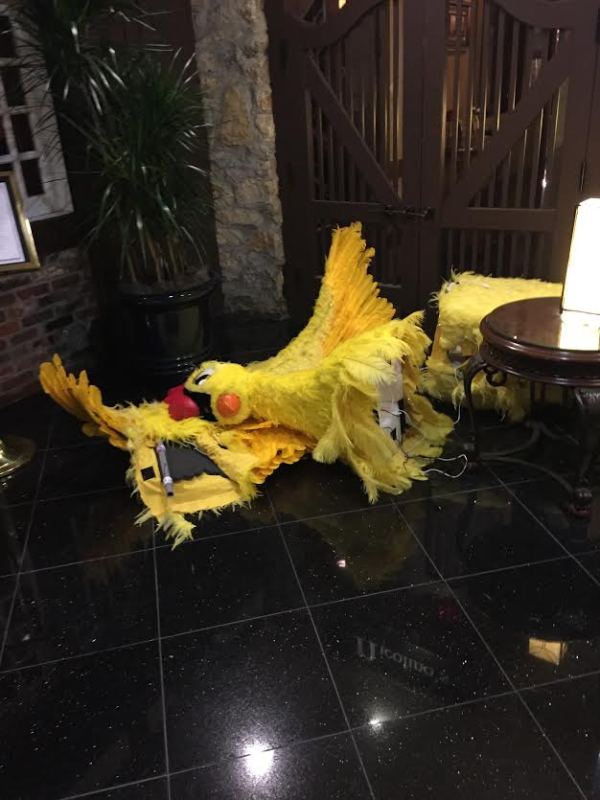
PHOTO PROMPT © Luther Siler
Word Count: 100 words of text, exactly
Genre: Realistic Metaphorical Fiction
Block-Cage
©December 9th, 2015
By Vijaya Sundaram
The prisoner beat his head against the cage, and died …
I stopped typing, and shook my head. I didn’t like the story.
My eight-year-old came into my room, saw the fallen bird, and said, “Sorry Mom, it fell when I reached up to touch it. I’ll fix it.” And she did, after which I hung it from its hook. For a moment, I looked at it fondly, smiling, then went back to my computer, erased my first line, and began again:
When the prisoner beat his head against the prison-bars, he grew wings …
Time melted away.
_______________________________________________
Thanks, as always, to our Fairy Blog-Mother, Rochelle Wisoff-Fields, for hosting Friday Fictioneers, and to Luther Siler for that surreal photograph!
Tags: Bird, Bird-cage, Setting, Writer's Block, Writing
Jul 28, 2014 Awake in Real Time: Coffee-induced Meditations and Journal Entries, Current Affairs / General Interest, Reading, Teaching and Learning, Thinking, Writing
And here we are, comfortable, with our little, daily stresses and cares, our worries, or work-related sorrows, or the baggage we carry from our lives.
And there they are, in Gaza, which is burning, with Israeli artillery strikes or misfired Hamas rockets.
Or in Baghdad, where Sunnis are being harassed by Shias.
Or, in Ukraine, where there are hundreds of civilian deaths, while governments fight for control in one direction or another.
This isn’t a world in which I wish to live.
And yet, life IS beautiful. And Life is Beautiful, too.
We MUST try and speak for beauty, for life, for love, for peace.
We MUST end the little stesses in our own lives by being non-reactive, thoughtful, calm and measured. (Of course, that’s easier said than done — but I’d like to try.)
Plant a garden of flowers, however small your yard is. If there’s no yard, make a window garden.
Plant some tomatoes and basil in a box outside your window sill.
Plant a tree in a park.
Read a book, or write one. Or, do both.
Teach a child to read a book or listen to music.
Write to your congressmen and congresswomen, and to your leaders.
Play music with your family, your friends, by yourself.
Play.
_________________________________________________________________________
Tags: #Trees, Baghdad, Gaza, Israel, life here and there, planting flowers, Playing, Playing music, reading, Teaching a child to read, Ukraine, vegetables, Writing
Feb 10, 2014 Awake in Real Time: Coffee-induced Meditations and Journal Entries, Reading, Writing, Thinking, Teaching and Learning
So, one of the nice things my school system does is to offer various workshops and seminars through a lovely Professional Day program. We sign up, get chosen to go by lottery, and then choose from a menu of wonderful offerings. If we are fortunate enough, we get what we want from that menu, and even if we don’t get our first choice, we still get to go for excellent seminars. I’ve gone for several workshops and seminars (many of them which offered me my first choice) over the past ten or more years, and every single one was satisfying to me as a teacher and as a student, because I always brought back ideas, both into my own personal practice of writing, and also into my professional practices as an English teacher.
I was fortunate this year, because I signed up for, and got to go to, a creative writing seminar with Michael Downing, author and Creative Writing Professor at Tufts University.
I missed the first Friday, because we had parent-teacher conferences. I went for the next two Fridays, and both were excellent. The focus was on Flash Fiction and Micro-Fiction. Mr. Downing gave excellent prompts, as well as deeply satisfying talks and feedback on the process of creative writing. I came away, feeling both inspired and somewhat overawed by the uphill slope I have to tackle as a writer.
I won’t go into all that here, however. I just wanted to say that I had such a good time, I wondered why I was not doing more writing. Yes, yes, I’ve written on my blog almost every day, except, oddly, for the past three weeks. However, I do need to get out there, and attend more workshops, create or join a Writing Group, meet with said group, give feedback, receive feedback, and read more.
I want to do all of this, as well as teach 8th Grade English, grade hundreds of papers, practice guitar, go on walks in the woods with family, cook, clean and be a good, home-schooling mom to my wonderful little nine-year old daughter, take her to swimming and dance class on the weekends, because my husband takes her everywhere else during the weekdays, while I’m teaching, and generally be upbeat and organized. Now, we’ll soon be adding a Standard Poodle pup to the mix, and I think I know I shall officially be the most distracted person on the planet, at least for a few weeks.
I’m upbeat, however. My problem is that I love doing all of those things. I love writing, I love teaching, I love being a mother, a musician, a housewife. (I could do without grading and other administrative tasks attendant upon that).
Choose! I can hear a disembodied voice saying to me.
But I don’t want to choose! I want to push the edges of the day in either direction, maybe add about four more hours to it, and have those hours book-end my writing.
Mmmm … that would be most satisfying.
(Shakes herself out of dream-state, and looks briskly around).
Right. Where were we?
Ah yes, the workshop. My next three posts will be the prompts that Michael Downing gave, and my two drafts of each of the three stories I wrote. Hope you enjoy them.
_______________________________________________________________________________________________________
Tags: Distraction, Flash Fiction, Michael Downing, Micro-Fiction, Work and Play, Writing, writing workshop
Dec 8, 2013 Awake in Real Time: Coffee-induced Meditations and Journal Entries, Parenting/ Home-schooling / Family Music and other Notes, Reading, Writing, Thinking
Why Should I Write? A Conversation
©By Vijaya Sundaram
December 8th, 2013
The child at the table, brow furrowed, writes about her day with her best friend.
Why should I write? she moans.
If only things didn’t need to be written down! she exclaims, plaintively. I have them in my head, she adds.
The mother says, Keep writing. Describe what you saw today, when you and your friend went to see The Nutcracker ballet. Describe what you liked, how you felt, what you both did after the ballet, where her parents took you and her afterwards.
Why should I write? moans the child, again.
The mother, sympathetic but strict, says, Because it’s good to remember it. It’s good to describe it all. It’s good to reinvent it. Don’t you enjoy reading? Writing is the same thing, except you’re making it happen. Write what happened today. That’s all. Write about your fun day. That’s how you’ll remember it.
I do remember it. I don’t need to write it down, says the child, stubborn, but still obedient, pencil poised reluctantly in hand.
Well, you describe everything so vividly when you tell me, so just write it all down, and then we’ll both be able to remember it, says her mother, kind, but firm, unyielding.
I do remember it. I don’t need to write it down, repeats the child.
But not seven or ten years from now, says her mother.
The girl pouts, But I will. How do you know I won’t?
The mother sighs.
Just write, darling, she says. It’s the doing and the practice that makes us get better at it, and we will look back on it, and enjoy it … later, when we’re older,
And she bends over her students’ papers. Several years of grading practice haven’t made her any faster, she thinks. Then, she thinks of the book she hasn’t finished writing.
A vast sigh fills the room.
Silence reigns.
~~~~~~~~~~~~ The End ~~~~~~~~~~~~~~~~~~~
Tags: #Mother and Daughter, practice, why should I write?, Writing, writing rationales
Dec 3, 2013 Awake in Real Time: Coffee-induced Meditations and Journal Entries, Reading, Writing, Thinking
So, you want to write?
What’s stopping you? The dirty dishes, the laundry, the papers you need to grade, the rooms that need to be picked up, the people you’ve to get along with or work with, the children you need to wake up and off to school with a good lunch and change of clothes, the spouse you’ve got to make feel valued, the backlog of books that wink in your direction, then whistle and look away when you turn to gaze back at them, the dust balls reproducing quietly in corners when your back is turned, the instruments you used to play, but you cannot, because you’ve got work to do, anyway, the dog or cat that clamors for your attention, that cup of cappuccino that you’ve got to have at 5:00 p.m. when the muse is knocking at your window, semaphoring madly, but you’re too tired to answer, and what good would it do, anyway, because, even if you were to let it in, you’d pass out from everything you’ve been doing, or not been doing?
Oh. Well. Surely *that’s* not what’s stopping you, is it?!
You’d better get on it, hadn’t you? Pick up your pencil, your pen, your tablet, your laptop, your languishing spirit and WRITE, dammit!
~~~~~~~~~~~~~~~~~ Dreamer of Dreams ~~~~~~~~~~~~~~~~~
Tags: being anything except a writer, being busy, being domestic, feeling guilty about not writing, making excuses for not writing, not writing, wasting time, Writing
Apr 26, 2013 Uncategorized
Listening to Poetry
©By Vijaya Sundaram
April 26th, 2013
The children listen, in a spell
As the words of the poem we
Read aloud together in class,
Unreel and hook them, unawares.
Poetry, that smiling looter
That thief of all cynical hearts
That bandit of their mundane minds
Captures them, binds them all, tightly.
For a moment, cynicism
Is suspended, pushed, held at bay
By words, written quite long ago
Among differently moulded minds.
Then, mundane memory floods back
And, unwilling to be found out,
They replace their masks and move on
To the next silly or sublime sphere.
If I could capture their quiet
Concentration, their absorption,
I’d create an essential oil
With which to make a sweet perfume.
I’d keep it at my lonely desk
Spray it into the air near me,
And inhale deeply when sudden
Unexpected despair grabs me.
I’d forget my ache, then, and smile
I’d remind myself that this is
Why I love to teach and why I stay:
Concentration concentrated,
The shared delight, the rich shaping
Of our mutual enjoyment:
Pleasure distilled and stoppered in time
And fragrant in our memory.
~~~~~~~~~~~~~~~~~ The End ~~~~~~~~~~~~~~~~~
Tags: #NaPoWriMo, #Original Poetry, Concentration, Pleasure in poetry, students and teacher, Teaching and Learning, Teaching Poetry, Writing
Mar 29, 2013 Awake in Dream Time - Journal Entries about the almost real, the surreal and the unreal, Reading, Writing, Thinking
Death, and all that Dark Stuff …
©By Vijaya Sundaram
March 29th, 2013
The dead are never really far from us.
I imagine them around me every day.
When I shut my eyes at night, and sink, awake, into the blackness under my eyelids, I feel a momentary sense of terror, as if I’m floating away, unanchored, into space. Then follows a quiet exhilaration. I know sleep will follow, and that’s a lovely, glowing, cushiony thought.
I wonder whether the dead feel this way upon dying. Do they float around in inky blackness, wondering when they’ll awake, but knowing they never will, and so, they burrow under our subconscious and visit us in our dreams, just to feel at home, if only for a night?
Or, do the dead just drift away?
Can we accept the word of those who’ve “come back” just because they came back? How do they know what happens after? They’ve come back, haven’t they? So, they didn’t venture that far.
If only one could write after death. I would love that.
~~~~~~~~~~~~~That’s all, folks!~~~~~~~~~~~~~~~
Mar 29, 2013 Awake in Dream Time - Journal Entries about the almost real, the surreal and the unreal, Essays: On Books, Art, Literary Appreciation and so on, Reading, Writing, Thinking
On Neil Gaiman and Fearlessness
©By Vijaya Sundaram
March 29th, 2013
Ever since the day I first encountered The Sandman series, I have loved and admired that possessed writer-and-venturer into perilous territory — Neil Gaiman.
He takes his books, his themes and characters far afield, into terrible, sometimes disgusting, sometimes amazing territory, but somehow, he tends to bring our favorite people safely home, and as in Coleridge’s poem, his characters and his readers often wake up, “sadder and wiser” on the “morrow morn.”
I love how he shares his work, his advice and his ideas so generously. Like all true writers, he seems to sense that we draw from the same deep well of stories that have moved, nourished or startled our spirits since time began.
I recognized Neil as a fellow-dreamer when I first read The Sandman series. I, too, had strange dreams. I, too, imagined the Lord of Dreams, because I had steeped myself in Greek mythology since I was a young girl. I wrote stories and songs about these well before I had read his work. Then, I read him, and he blew my mind with his tender blend of love and terror. His imagination is completely unfettered, and his intellect is a joy to behold.
And he always goes farther into scarier territory than many writers (and I don’t mean in the realms of horror, per se, just imagination), farther than I have dared in any of my stories — and his books, The Sandman series, American Gods, Neverwhere, Coraline and The Graveyard Book have pushed the edges of the story-telling universe.
And he inspires me to find my own way into those places — and again, I don’t mean horror, just daring, the kind of daring that makes a person take one step back, and then take a flying leap into the abyss, with absolute certainty that he will land on his feet.
Thank you, Mr. Gaiman!
~~~~~~~~~~~~~~~~~~~~ The End ~~~~~~~~~~~~~~~~~~~~~~~~~
Tags: Creativity, Fearlessness, Neil Gaiman, Writing
Mar 3, 2013 Awake in Real Time: Coffee-induced Meditations and Journal Entries, Teaching and Learning
Curiously, it didn’t hurt. It didn’t do much of anything, except to create a sense of dull satisfaction: Yup. I knew my poems didn’t suit their needs, but I sent them off anyway.
Realism, thy name is DreamersOfDreams.
It must be because I’m almost forty-nine — the almost part is crucial.
It must be because I know how long a struggle all this is for most writers. That’s why, I guess, they send stuff off when they’re in their twenties.
I didn’t do that in my twenties. I was too busy struggling to find a footing, instead. Married to an American, and finding myself on American soil for the first time at age twenty-four, I looked for work and found it in an independent record label and distribution company in Cambridge, Massachusetts.
Working between ten and fourteen hours a day at $4.25 an hour for the first year, standing on concrete floors, pushing a shopping cart from aisle to aisle, picking LPs, cassettes and CDs, packing them, and shipping them via UPS, I got a taste for what it meant to be really low on the totem pole. Forced to listen to strange LPs played by angry young men during work hours, who indulged in mindless vulgarity and obscene epithets strewn carelessly about, I winced in almost-physical pain and went home to practise jazz and Indian classical music with a loving and kind husband.
For that first year, despite the hours of badly recompensed, and mindless, labor during the day, we composed music, played together, saw movies on the weekends at the Capitol Theatre in Arlington, and ate out at an Indian restaurant once a week. I wrote short stories, poems and songs. He composed his music. We performed together. I had vivid dreams. I felt newly born, innocent.
We owned hardly anything — just books, instruments, cassettes and LPs, and later, CDs. I wore old clothes, dressed oddly, didn’t much care for the trappings of middle-class modes of dress and manner. My husband and I were in love, we had music, we had a good, rich-in-music, if financially-impoverished life. Music saturated our waking and sleeping hours, and it was beautiful.
I realized that all my ambitions of my early college years had taken a back seat to all this creative sweetness. It was enough to do music, practise voice and guitar, get better at singing and song-writing and take long walks, after a rough day at the warehouse. It was enough to be content.
I used to be ambitious. It had all vanished.
This is not to say there weren’t troubles in our life. Somehow, anything that smacked of trouble in my life simply rolled off my back. People use the phrase, “water off a duck’s back.” I prefer my mother’s beautiful image in Tamil — “water off the petals of a lotus.” That was what she’s been like all her life. Troubles, terrible troubles, financial and medical, happened to her and my father. She withstood it all, and seems to grow every year into a more beautiful, complete person.
We had our troubles too. I don’t remember them, not much, anyway.
Over the years, my husband and I grew in music. We went back twice for a year at a time to study with our beloved Indian classical vocal teacher, Pandit S.G. Devasthali (now “late,” to use the classic phrase used by Indians as well as Batswana people, like the fictional Mma Ramotswe). We performed Hindustani classical vocal together. I wrote many songs, composed surreal music, arranged them for sax, ‘bone, bass, guitar and drums (my husband’s ensemble, Antigravity), and later for sitar, dilruba, flute, Indian violin (with our dear friends playing those instruments, in the Indian version of Antigravity). I played my songs in coffeehouses and the streets of Harvard Square, as well as the subways and made grocery money. We slept on a futon bed and used milk-crates with cushions as chairs in the living room. Drank a lot of black coffee. Ate veggie-lentils and rice. One can do that in one’s twenties.
I continued to work at the company. Rose in wages, rose on the totem pole, not dramatically, just steadily. Then, came the urge to get settled –that dreaded phrase, which smacks of middle-class ambition and morality. The urge to become a teacher had become paramount. I enrolled in an M.Ed. program at Lesley College, now Lesley University, got my degree, worked as Teaching Assistant in a Cambridge School, while doing my college courses in the evening, got my license, got a job at a nearby school (while finishing the last of my graduate courses and graduated), and have been at that suburban school ever since.
Then, came the house and the grinding work of rebuilding a wreck of a place, while living in it, dust and all. Then, came our daughter. Now, it’s all about teaching, being domestic and homeschooling. I love it all.
And I also miss all that music and creative writing that I used to do.
Ambition is making a comeback, rather late in my life. I’m not crazy-ambitious, just enough to want to publish my three plays, all those short stories I’ve written, all those poems I’ve poured out, and at least one novel before I die.
I want to write, just write. I don’t want to do much else, sometimes. However, I also love to teach. I love singing and playing music. I love bringing up my daughter.
So, I’ll try and fashion a life in which all these strands are inter-woven, and they’ll create a tapestry which will make sense for me.
And I won’t let any rejections get in my way.
~~~~~~~~~~~~~~~~~~The End~~~~~~~~~~~~~~~~~~~~~~~~~~

Tags: #Music, Antigravity, Cambridge, Harvard Square, looking back, Massachusetts, Rejection letters, Rounder Records, Writing